
If your blast chiller keeps losing gas and needs regassing again and again, it has a leak, and a top-up only replaces gas that has already escaped. The real fix is to find the leak, repair it, prove the repair holds, and only then recharge. If a leak is found during a leak check, UK F-Gas rules say it must be repaired as soon as possible.
Why topping up isn’t a fix
Refrigerant isn’t used up like fuel. If your chiller keeps running low, the gas is escaping, and a top-up only works until it escapes again. Meanwhile:
- You pay for the same gas again. Every top-up means another callout and more refrigerant. Gas is also likely to get dearer: the GB supply quota for HFC refrigerants is due to fall by 22.6% on 1 January 2027 (Cooling Post).
- Food safety is at risk. As the Food Standards Agency puts it, a blast chiller is “specially designed to chill down hot foods quickly and safely” (FSA Safer Food, Better Business). A chiller that’s short of gas cools more slowly, so food spends longer at temperatures where bacteria grow, and your cooling records start to show it.
- It lets you down when you’re busiest. A chiller short of gas struggles most with a full load of hot food, and the compressor works harder, which can turn a small leak into a much bigger repair.
Why blast chillers leak more than most
A blast chiller works harder than almost anything else in your kitchen:
- Big daily temperature swings. Hot trays go in and the chiller pulls them down fast, several times a day. Pipes and joints expand and contract with every cycle, and over months that stress can open up a tiny crack.
- Door use. Every door opening lets in warm, moist air, and the system has to work hard again.
- Vibration. Fans and the compressor shake the pipework, slowly working at joints and fittings.
That’s wear from the job, not a badly made chiller. If you’re also seeing warm freezers, our guide to a freezer breakdown covers the warning signs.
What a proper repair looks like
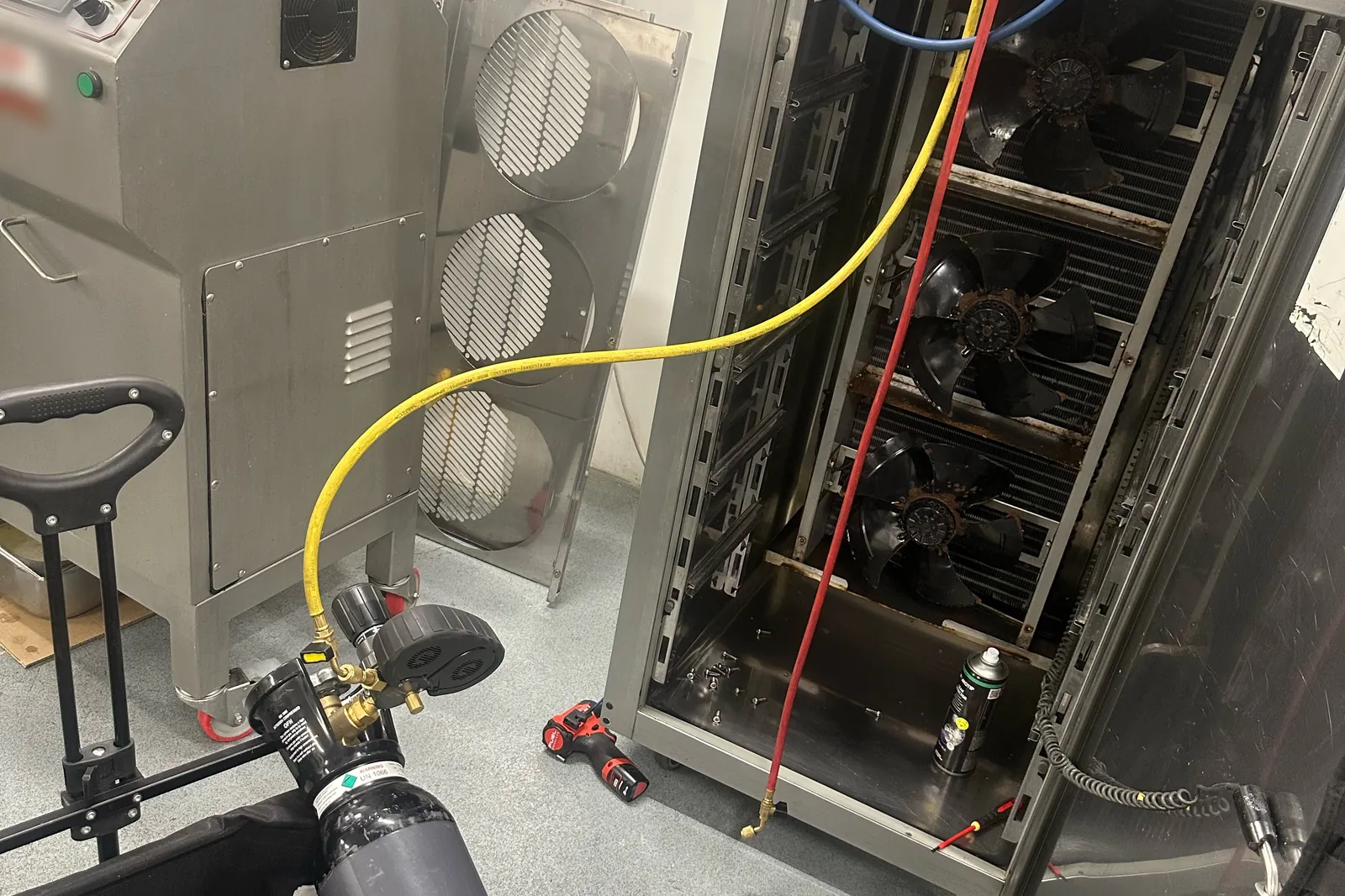
This photo is from one of our blast chiller jobs: the unit is opened up, with an oxygen-free nitrogen cylinder and hose connected for a pressure leak test. A proper repair goes like this:
- Recover the remaining gas. Any refrigerant left in the system is safely recovered, never vented.
- Pressure test with nitrogen. The system is filled with oxygen-free nitrogen and the gauge is watched. If the pressure drops, there’s a leak, and the engineer tracks it down. No refrigerant is wasted while hunting for the fault. Industry guidance such as REFCOM TB017 covers how to allow for temperature changes during the test.
- Repair the leak. The leaking joint, pipe or part is fixed or replaced.
- Retest. The system is pressurised with nitrogen again. If the pressure holds, the system is tight.
- Evacuate. A vacuum pump removes the nitrogen, air and moisture.
- Recharge. The right type and amount of refrigerant goes back in, and the engineer checks the chiller pulls down properly.
- Record it. The engineer writes down what was found, what was done and how much gas went in.
It takes longer than a top-up, but it’s the difference between a repair and a return visit. For more on the units we look after, see our blast chiller repair page.
What the law says
GOV.UK guidance on checking F-gas equipment for leaks is clear: if you find a leak during a check, “you must repair it as soon as possible and repeat the test within a month to check the repair worked.”
- It’s a shared responsibility. Both you, as the user of the equipment, and your engineer are responsible for stopping leaks.
- Check frequency depends on the gas. It depends on how much refrigerant the chiller holds and which type. Your engineer can tell you whether yours needs regular checks.
- Records must be kept. For equipment that needs them, you must keep records for five years, including gas added and the dates and results of leak checks (GOV.UK).
- Use certified engineers. Anyone working on the refrigeration circuit needs an F-Gas qualification, and a company servicing equipment for other businesses must be certified. All Frostberg engineers are F-Gas certified.
Questions to ask your engineer
- Where exactly was the leak, and how did you find it?
- What did you repair?
- Did you pressure test it after the repair, and did it hold?
- What gas went back in, and how much?
- When is the follow-up check due?
- Can I see your F-Gas certificate?
If the answer to “where was the leak?” is “we just topped it up”, the problem is still there.
The paperwork to expect
After a leak repair, you should get a written job report showing:
- the date and the engineer’s name and F-Gas certificate number
- where the leak was and what was repaired
- the pressure test result after the repair
- the type and amount of refrigerant recovered and added
- when the follow-up leak check is due
Keep it with your F-Gas and food safety records.
Frequently asked questions
Why does my blast chiller keep losing gas?
Because it has a leak, usually at a joint, pipe or part stressed by daily hot-to-cold cycles, door openings and vibration.
Is it legal to just keep topping up a leaking blast chiller?
If a leak is found during a check, the law says it must be repaired as soon as possible and rechecked within a month. A top-up on its own doesn’t repair anything.
Can I keep using my blast chiller while it’s low on gas?
Only if it’s still chilling food within your safe chilling times. Check your cooling records and probe readings. If food is taking longer to chill, don’t rely on the chiller until it’s repaired.